
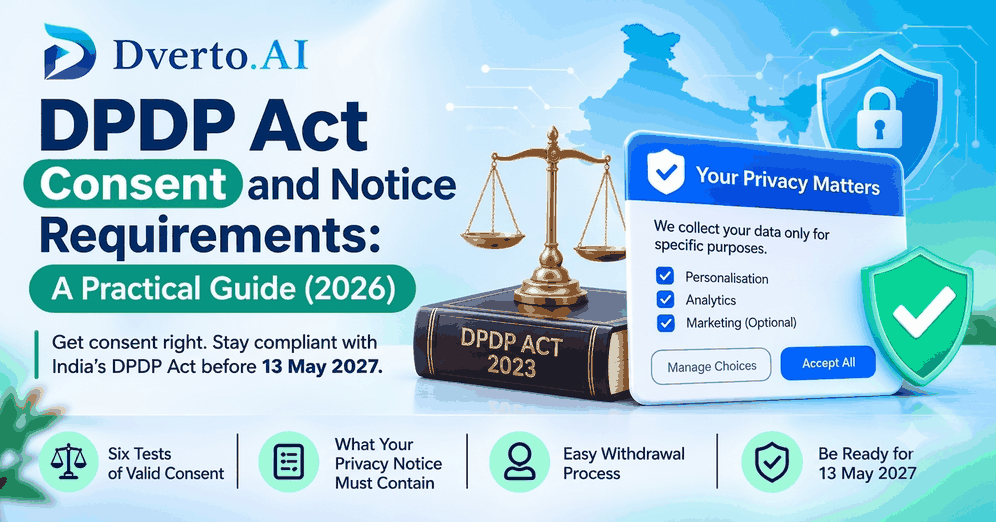
Most Indian businesses will not fail the DPDP Act because they lacked a privacy policy. They will fail because their consent flow did not hold up when someone actually looked at it.
India's Digital Personal Data Protection (DPDP) Act, 2023 makes consent the primary lawful basis for processing personal data, and the DPDP Rules, 2025 turn that principle into operational requirements: what the notice must say, how consent must be captured, what a valid consent record looks like, and how easily a person can take their consent back.
With the core obligations commencing on 13 May 2027, consent is no longer only a legal drafting task. It is a product, engineering and data-governance problem. This guide breaks down the consent and notice requirements and turns them into an implementation checklist. For the wider legal picture, read our complete DPDP Act compliance guide for Indian businesses first.
Why Consent Sits at the Centre of the DPDP Act
The Act follows a consent-first model. Personal data may be processed only for a lawful purpose, and only either on the basis of the Data Principal's consent or for one of the limited legitimate uses listed in the statute. The default assumption is consent; every other basis has to be identified and justified.
Two practical consequences follow. First, the burden of proof sits with the Data Fiduciary: the business decides what personal data is collected and why, so it must be able to demonstrate that a valid consent existed for each purpose. Second, consent is not a single event at signup. It is a lifecycle of notice, collection, record-keeping, use, sharing with processors, withdrawal and erasure.
The Six Tests of Valid Consent
Section 6 requires consent to be free, specific, informed, unconditional and unambiguous, given by a clear affirmative action, and limited to the personal data necessary for the stated purpose. Each of those words rules out a common design pattern.
There is also a data-minimisation test inside consent itself: the consent must cover only the personal data necessary for the specified purpose. Asking for a phone number, date of birth and address just in case weakens the consent even if the box was ticked.
What Your Privacy Notice Must Contain
A consent request is only as good as the notice behind it. Section 5 requires the notice to be served before or alongside the consent request, and to be clear, standalone and in plain language. It must cover:
- An itemised description of the personal data being collected and the purpose of processing.
- The goods or services for which the data is collected, where applicable.
- How the Data Principal can exercise their rights, including access, correction, erasure, grievance redressal and nomination.
- How the Data Principal can complain to the Data Protection Board of India.
The Act also expects the notice to be available in English or any language listed in the Eighth Schedule of the Constitution, so that consent is genuinely informed for the audience you serve. For a worked example, see how Dverto's privacy policy structures purposes, retention and the route to exercising rights.
Use a layered notice
A single long document rarely gets read on a mobile screen. A layered structure works better and still satisfies the requirement:
- Layer 1 - just-in-time banner: the purpose, the data involved and a link to the full notice, shown at the moment of collection.
- Layer 2 - purpose-level summary: a short panel for each use case, such as analytics, personalisation or marketing.
- Layer 3 - full notice: the complete, versioned document with retention periods, recipients, cross-border transfers and grievance contact.
Version the notice and log which version each person saw. When the notice changes materially, the consent, not just the notice, usually needs to be refreshed.
Consent Managers and the 13 November 2026 Milestone
The Act introduces a new intermediary: a Consent Manager. Registered with the Data Protection Board, a Consent Manager acts as a single point of contact for a Data Principal to give, manage, review and withdraw consent across multiple Data Fiduciaries, and is accountable to the Data Principal.
The provisions that operationalise Consent Managers, namely sub-section (9) of Section 6 and clause (d) of sub-section (1) of Section 27, commence on 13 November 2026, according to the commencement notification (G.S.R. 843(E)). The rest of the substantive obligations follow on 13 May 2027.
You do not have to appoint a Consent Manager. But if you operate at scale, your systems should be ready to accept a consent decision that originates outside your own interface, honour a withdrawal received through that channel, and keep a verifiable record of it.
Withdrawal Must Be as Easy as Giving Consent
Consent under the DPDP Act is reversible by design. A Data Principal may withdraw consent at any time, and the withdrawal must be as easy as giving it. The Act also makes the consequences explicit: once consent is withdrawn, processing must stop unless another lawful basis applies.
Withdrawal does not make earlier processing unlawful, but it does start a clock. Design for it directly:
- A self-serve consent dashboard, rather than an email to a support inbox.
- A one-click unsubscribe or withdrawal link in every marketing communication.
- Immediate suppression across systems, including processors and marketing tools.
- A timestamped audit trail showing when the withdrawal was received and when each downstream system acknowledged it.
- A clear explanation of what changes after withdrawal, without punitive or confusing friction.
Dark patterns are a compliance risk here. If cancelling takes five screens while signing up took one tap, the withdrawal mechanism is unlikely to be treated as equally easy.
Processing Without Consent: The Legitimate Uses
Section 7 lists the situations where personal data may be processed without consent. The common ones for businesses are:
- The Data Principal has voluntarily provided the data and has not indicated that it should not be used.
- Processing is necessary for the State to provide a subsidy, benefit or service, or to perform a statutory function.
- Processing is necessary to comply with a legal obligation or a court order.
- Processing is necessary for employment purposes, or to protect an employee from a medical emergency.
- Processing is necessary to respond to a medical emergency, epidemic or disaster.
- Processing is necessary for research, archiving or statistical purposes in the public interest, subject to prescribed standards.
These are narrow, purpose-bound exceptions, not a general licence. Notice and security obligations still apply, and you should record which legitimate use you are relying on for each processing activity, together with the reasoning behind it.
Children's Data and Verifiable Parental Consent
The Act treats anyone under 18 as a child. Before processing a child's personal data, a Data Fiduciary must obtain verifiable parental consent in the prescribed manner. Behavioural tracking, behavioural monitoring and targeted advertising directed at children are prohibited, and processing that is likely to cause a detrimental effect on a child's well-being is off-limits.
The Rules carve out limited exemptions, for example certain processing by healthcare professionals, educational institutions and transport providers, but those exemptions are specific rather than blanket. If your product can be used by minors, build age assurance and a parental verification path before launch, not after a complaint.
Your Consent Implementation Checklist
The compliance timeline sets the pace.
Work backwards from 13 May 2027 with this sequence:
- Map the data. Inventory every form, SDK, cookie, CRM field and vendor integration that touches personal data.
- Assign a lawful basis. Mark each processing activity as consent-based or as a Section 7 legitimate use.
- Rewrite the notice. Itemise data and purposes, add rights and Board complaint routes, and publish it in the languages your users read.
- Rebuild the consent flow. Purpose-level toggles, no pre-ticked boxes, equal prominence for accept and reject, and a clear affirmative action per purpose.
- Log the evidence. Store the consent artefact, timestamp, user identifier, notice version, purposes selected and the interface used.
- Ship withdrawal. Self-serve, one click, propagated automatically to processors.
- Stand up a rights workflow. Access, correction, erasure and grievance requests with owners, service levels and audit logs.
- Fix the contracts. Processor agreements must oblige vendors to act on withdrawal and erasure instructions, and to report breaches.
- Set retention and erasure. Define retention periods per purpose and automate deletion when they expire.
- Test and train. Run a consent audit, then brief product, marketing and support teams on what they can and cannot do with data.
Five Mistakes That Undermine a Consent Programme
- Treating consent as a one-time banner. Consent is per purpose and per notice version; a banner accepted in 2023 may not cover a use case added in 2026.
- Bundling everything into one checkbox. It feels efficient and is one of the easiest failures to spot.
- Keeping no proof. If you cannot show what the person saw and when, you cannot demonstrate valid consent.
- Making withdrawal painful. Friction that protects retention becomes evidence against you.
- Forgetting processors. Consent does not automatically travel to vendors; your contracts and integrations must carry it.
Getting Started
Consent is a small enough surface to fix quickly and a broad enough obligation to touch almost every system. Start with the two highest-risk journeys, account signup and marketing capture, rebuild them end to end, and use that work as the template for the rest.
If you have not yet mapped the wider obligations, the DPDP Act compliance guide for Indian businesses covers the timeline, penalties and the role of Significant Data Fiduciaries. Together, the two pieces give you the legal frame and the implementation plan.
Beyond this guide, browse the Dverto blog for more practical compliance and engineering write-ups. If you are building consent into a hospital or clinic product, see our healthcare software practice. To review your own consent flows with us, contact the Dverto team.
Got Questions? We've Got Answers
Q1 Is consent always required under the DPDP Act?
No. Consent is the default basis, but Section 7 lists limited legitimate uses, such as legal obligations, employment, medical emergencies, State functions and certain public-interest research, where personal data can be processed without consent. Those uses are purpose-bound, and notice and security obligations still apply.
Q2 Can we use pre-ticked checkboxes or implied consent?
No. Consent must be unambiguous and given by a clear affirmative action, so pre-ticked boxes, consent by silence and consent inferred from continued browsing do not meet the standard.
Q3 How long should consent records be kept?
Keep records for as long as you rely on the consent and for the period your retention policy or legal obligations require. A usable record includes the consent artefact, timestamp, notice version, purposes selected and the interface used, so you can demonstrate compliance if challenged.
Q4 Does the DPDP Act apply to employee and HR data?
Yes. Personal data of employees is in scope. Employment is a recognised legitimate use for certain processing, but notice, security safeguards, retention limits and grievance handling still apply to HR systems.
Q5 What is the penalty for processing children's data without verifiable parental consent?
Breach of the additional obligations in relation to children can attract a penalty of up to 200 crore rupees under the Schedule to the Act. Behavioural tracking and targeted advertising directed at children are separately restricted.
Q6 When do the main consent obligations take effect?
The core obligations commence on 13 May 2027. The DPDP Rules were notified in November 2025, and the provisions enabling Consent Managers commence on 13 November 2026.
Related Blogs
More in Security
DPDP Act Compliance Guide for Indian Businesses (2026)
India’s DPDP Act is rolling out in phases, and the biggest obligations kick in on 13 May...