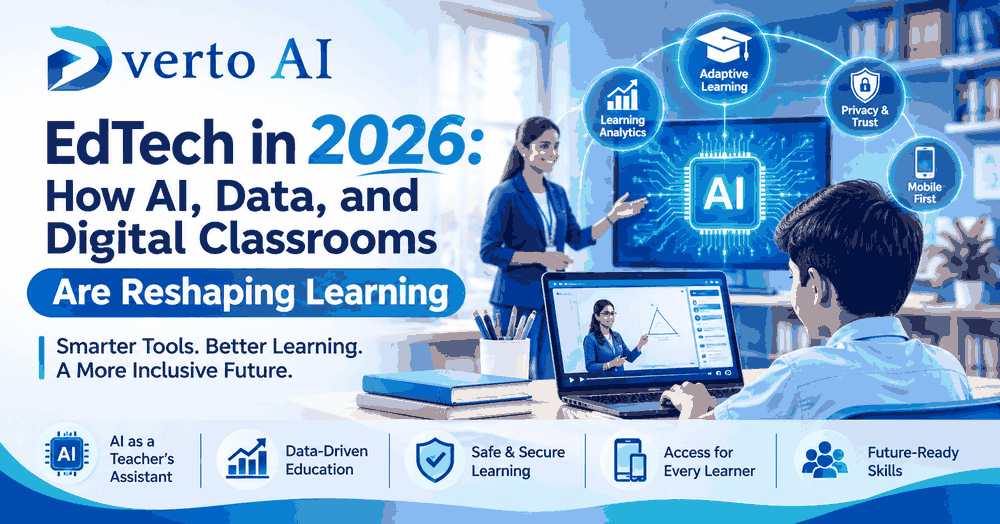
EdTech's second act: from gadgets to outcomes
Every technology cycle has a honeymoon phase. For education, that phase was defined by smartboards, tablets and learning management systems that promised to modernise teaching simply by moving it online. The tools mattered, but the results were uneven. In 2026, the sector is entering a more mature chapter, where technology is judged by whether it helps a teacher teach better, a student learn faster, and an institution run with fewer blind spots.
The shift is visible in the questions buyers ask. Instead of starting with a feature list, school leaders and university administrators now ask about integration, accessibility, data protection and total cost of ownership. That is progress. EdTech is no longer a novelty budget line; it is part of the operating model of education.
The most useful question is no longer "Is this digital?" It is "Does this help someone learn?"
Six shifts defining education technology in 2026
1. Adaptive practice replaces one-size-fits-all content
Static PDFs and recorded lectures still have a place, but they are no longer the centre of a modern learning experience. Adaptive systems watch how a learner responds to a question, adjust the difficulty, and surface the next concept at the right moment. The aim is not to keep students busy. It is to keep them in the productive zone where the work stretches them without pushing them out.
For institutions, the practical test is simple: can the platform explain why it recommended a particular activity, and can a teacher override it? A system that cannot answer both questions is a black box, not a teaching tool.
2. AI becomes a teacher's assistant, not a substitute
The most credible AI use cases in education are unglamorous. They include drafting lesson plans, generating practice sets, summarising long discussion threads, translating materials, and flagging learners who may need support. These tasks consume hours of administrative time every week, and automating part of them gives teachers more room for the work only humans can do: noticing confusion, asking a better question, and building trust.
That is also the right way to think about AI automation in education. Start with a repetitive workflow, measure the time saved, and keep a human review step for anything that affects a learner's record or future.
3. Analytics must lead to action
Dashboards are easy to buy and hard to use. A screen full of charts does not help anyone if it cannot answer three questions: who needs help, what kind of help is likely to work, and did the intervention make a difference? The strongest learning analytics setups connect attendance, assessment and engagement data, then route a short, specific action to a teacher or mentor.
Privacy matters here as much as accuracy. Collect the minimum data required, limit access by role, and delete what is no longer needed. Analytics should serve learners, not surveillance.
4. Mobile-first and low-bandwidth design
Not every learner arrives with a laptop and reliable broadband. In many parts of India and other emerging markets, a mid-range phone is the primary device, and connectivity can drop without warning. EdTech that assumes otherwise excludes the students who need it most.
Good mobile development for education means offline-first content, compressed media, clear progress states, and graceful recovery when a session fails. It also means testing on real devices and slow networks, not only on a fast office connection.
5. Privacy, safety and trust as product features
Student data is among the most sensitive information an institution holds. It can reveal learning difficulties, health needs, family circumstances and behaviour. India's Digital Personal Data Protection Act, 2023 raises the bar for consent, purpose limitation, retention and breach response, and it places additional expectations on processing children's data.
Treat privacy as a design requirement, not a policy document. Ask vendors where data is stored, who can access it, how long it is retained, how exports and deletion work, and what happens during an incident. If those answers are vague, the risk is yours.
6. Assessment and credentials that travel
Learning increasingly happens across platforms, employers and institutions. That makes portable assessment and verifiable credentials more important than ever. Open standards such as LTI, SCORM and xAPI help content and results move between systems, while digital certificates can make achievements easier to verify.
The goal is not to credential everything. It is to make sure that when a learner earns something, the evidence is trustworthy and can follow them to the next opportunity.
What the evidence says, and what it does not
Technology is not a learning outcome. Reviews from UNESCO, the World Bank and the OECD point to the same conditions for success: clear pedagogy, teacher support, reliable infrastructure and sustained implementation. Devices alone rarely change results. Well-designed programmes that change how teachers plan, assess and intervene can.
Two cautions are worth keeping in view. First, more screen time is not automatically better learning. Passive video and click-through modules can feel modern while producing little understanding. Second, pilots often succeed because of extra attention and support, then fade when they scale. Plan for the boring parts: training, maintenance, content updates and someone who owns the outcome.
A practical adoption roadmap
- Start with a learning problem, not a product. Define the outcome you want to improve, such as reading fluency in early grades, completion rates in a vocational course, or the time faculty spend on assessment.
- Map the workflow end to end. Include admissions, identity, timetable, content, assessment, reporting and support. Most failures are integration failures, not feature failures.
- Pilot with a narrow group. Choose one programme, one cohort and a clear comparison. Keep the pilot small enough to support properly.
- Measure leading indicators. Track teacher time saved, learner participation, completion and support tickets, not only final exam scores that arrive too late to change anything.
- Plan for support after launch. Budget for training, content maintenance, accessibility reviews and a named owner. A platform without an operating plan becomes shelfware.
India's next chapter: NEP 2020, DIKSHA and multilingual learning
India's National Education Policy 2020 placed digital learning, teacher capacity and multilingual resources at the centre of reform. DIKSHA, the national platform for school education, shows what large-scale teacher-facing infrastructure can look like when it is designed around existing classroom practice.
For anyone building in this market, the design implications are clear. Support multiple languages and scripts. Assume low-end devices and intermittent connectivity. Respect state, board and institution-specific workflows. And make it easy for a teacher to adapt content rather than forcing a single national template onto every classroom.
Build, buy or blend?
Most institutions end up with a blend. Buy the commodity layer: video, email, identity and a baseline learning management system. Build the differentiator: the workflows, integrations and analytics that reflect how your institution actually teaches. Then integrate carefully rather than accumulating disconnected tools.
Before signing, check single sign-on through SAML or OIDC, data export and deletion, API limits, accessibility against WCAG 2.2 AA, support response times, and the exit plan. A platform that cannot return your data is not a partnership.
Dverto AI's education solutions cover learning management systems, virtual classrooms, student and faculty portals, AI tutoring assistants, analytics and secure SIS or ERP integration. Teams that need a broader build can also combine web development, cloud engineering and AI automation with the education practice.
The bottom line
EdTech in 2026 is less about the next shiny device and more about the quality of the system around it. The institutions that benefit most will be those that start with a real learning problem, choose tools that respect teachers and learners, protect student data, and commit to support after the launch announcement.
If you are planning an education platform, a virtual classroom or an analytics layer, the Dverto AI insights library and contact team are good places to continue the conversation.
Got Questions? We've Got Answers
Q1 What does EdTech mean in 2026?
EdTech now describes the software, data systems and services that support teaching and learning, from learning management systems and virtual classrooms to adaptive practice, analytics and AI assistants for teachers.
Q2 How is AI actually used in education today?
The most effective uses sit behind the scenes: lesson planning, practice generation, feedback drafting, translation and early-warning analytics. AI should keep teachers in control of decisions that affect learners.
Q3 Is EdTech proven to improve learning outcomes?
It depends on implementation. Technology alone is rarely linked to better outcomes; structured pedagogy, teacher training, reliable infrastructure and sustained support matter more. Pilots should be measured against clear learning goals.
Q4 How can institutions protect student data?
Collect less, limit access by role, set retention rules, vet vendors and align with applicable law such as India's DPDP Act, 2023. Plan for data export, deletion and incident response before launch.
Q5 How do you choose the right EdTech partner?
Look for domain experience, integration skills, accessibility and security practices, transparent support, and a clear data exit plan. Ask for references from institutions with similar needs.
Related Blogs
More in Education
No related blogs found in this category yet.