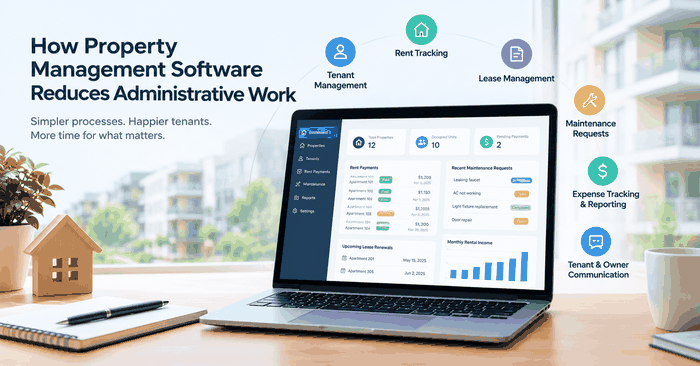
Property management software helps simplify these tasks by bringing important property information and routine workflows into a centralized digital system. Instead of relying on multiple spreadsheets, paper documents, and scattered messages, property managers can organize their daily operations more efficiently.
In this article, we explain how property management software reduces administrative work, which tasks can be streamlined, and how real estate businesses can choose the right solution for their needs.
What Is Property Management Software?
Property management software is a digital solution designed to help landlords, property managers, real estate companies, and property owners organize and manage their properties. Depending on its features, it can support rent tracking, tenant records, lease management, maintenance requests, expense tracking, communication, and reporting.
The main purpose is to reduce repetitive administrative tasks, improve access to information, and make property-related processes easier to manage.
Common challenges in traditional property management
Managing properties without a centralized system can create several difficulties:
Maintaining tenant details across multiple spreadsheets or registers.
Tracking rent payments and outstanding balances manually.
Searching for lease agreements and renewal dates.
Coordinating maintenance requests through calls and messages.
Organizing invoices, receipts, and property expenses.
Preparing reports for owners and management teams.
Keeping communication records organized across multiple properties.
These issues can become more complicated as a property portfolio grows. Property management software can help create more consistent workflows and reduce the effort required to manage everyday responsibilities.
1. Automating Rent Tracking and Payment Records
Rent collection is one of the most important administrative responsibilities for landlords and property managers. They need to know which tenants have paid, which payments are outstanding, and whether payment records are accurate.
When rent is tracked manually, staff may need to review bank transactions, update spreadsheets, send reminders, and reconcile records separately.
Centralizing rent information
Property management software can help maintain organized rent schedules, payment histories, and outstanding balance records. Authorized users can review payment information in one place instead of searching through multiple documents.
For example, a property manager overseeing several residential apartments can review which units have recorded payments and which accounts require follow-up. This makes routine tracking more organized and helps reduce manual recordkeeping.
Supporting timely payment reminders
Depending on the software's capabilities, automated reminders can notify tenants about upcoming or overdue rent payments.
These reminders can reduce the need for staff to contact every tenant individually. Payment records and reminders should still be reviewed to account for bank processing times, disputed transactions, and payments received through different channels.
The result is a more structured rent management process and improved visibility into rental income.
2. Simplifying Tenant Information Management
Property managers often need to maintain tenant contact details, occupancy information, lease documents, emergency contacts, and communication histories.
When this information is scattered across emails, paper files, and spreadsheets, finding the correct details can take unnecessary time.
Keeping tenant records organized
Property management software can provide structured tenant profiles linked to the relevant property or rental unit. Depending on the system, records may include contact details, lease information, payment history, and maintenance requests.
For example, when a tenant reports a problem with a rented apartment, the property manager can locate the associated record and review relevant information without searching through multiple folders.
Reducing duplicate data entry
A centralized system can help staff avoid entering the same information repeatedly across different records. Standardized forms and consistent data fields also make information easier to maintain.
Property managers should establish clear procedures for updating tenant details and restrict access to sensitive information to authorized personnel.
3. Managing Lease Agreements and Renewal Dates
Lease administration involves preparing agreements, recording important dates, tracking renewals, and maintaining documentation for each rental property.
Missing a renewal deadline or struggling to locate a signed agreement can create additional administrative work and potentially affect landlord-tenant relationships.
Organizing lease documents
Property management software may allow teams to store lease details, associate documents with specific properties, and review agreement terms when needed.
Instead of searching through physical files, staff can locate the relevant digital record, subject to the system's access controls and document storage capabilities.
Tracking important deadlines
Where supported, reminders and deadline tracking can help property managers monitor lease expirations, scheduled rent reviews, and upcoming renewals.
For example, a manager responsible for a commercial building can review upcoming lease expirations and contact the relevant parties in advance.
Software can support better planning, but property managers should still verify contractual terms, applicable legal requirements, and renewal decisions before taking action.
4. Streamlining Property Maintenance Requests
Maintenance management is another major source of administrative work. Property managers may receive requests about plumbing problems, electrical faults, damaged fixtures, cleaning, or other repairs through phone calls, email, and messaging applications.
Without an organized tracking process, requests can be overlooked or difficult to prioritize.
Recording and tracking maintenance issues
Property management software with maintenance features can help staff record issues, assign responsibilities, and monitor progress. Depending on the system, requests may include descriptions, dates, status updates, and supporting photographs.
For example, when a tenant reports a water leak, the property manager can create a maintenance request and track the repair from initial reporting to completion.
Improving coordination with service providers
A structured maintenance workflow can help managers communicate requirements to technicians or contractors and maintain a record of completed work.
It can also support better expense tracking when repair costs are recorded against the relevant property.
Regular review is still necessary to prioritize urgent issues, verify completed work, and ensure that properties remain safe and well maintained.
5. Automating Property Expenses and Financial Reporting
Property owners need visibility into rental income, maintenance costs, utility expenses, management fees, and other operating costs. Managing these figures manually across multiple properties can make financial reporting complicated.
Keeping expense records organized
Property management software can help record expenses against individual properties and organize supporting invoices or receipts where document management is available.
For example, a manager overseeing several rental units can categorize repair costs and review the expenses associated with each property rather than combining everything in a single spreadsheet.
Preparing reports more efficiently
Reporting features can help generate summaries of rent collection, outstanding balances, expenses, and other recorded activities.
These reports can make it easier to share operational information with property owners and identify areas that require attention.
The accuracy of financial reports depends on complete records, appropriate categorization, and regular reconciliation. Software can simplify reporting, but it does not replace professional accounting advice or financial review when needed.
6. Improving Communication With Tenants and Property Owners
Property management requires regular communication about rent, maintenance, access arrangements, lease renewals, and general property updates.
When conversations take place across different phone numbers, emails, and messaging platforms, staff may struggle to track requests or identify previous commitments.
Organizing property-related communication
Depending on its features, property management software may provide communication histories, request updates, notifications, or a centralized way to manage tenant inquiries.
This can help staff understand the status of an issue and reduce the need to ask tenants to repeat information.
Providing clearer updates
A structured communication process helps property managers share relevant updates and establish clear expectations. For example, tenants can be informed when a maintenance request has been received, scheduled, or completed if the system supports those notifications.
Good communication still requires timely responses, clear language, and human judgment, especially when handling complaints or urgent situations.
7. How to Choose the Right Property Management Software
The right software should match the properties being managed, the size of the business, and the team's everyday responsibilities. A solution that works for a small landlord may not meet the requirements of a company managing hundreds of residential or commercial units.
Identify your most time-consuming tasks
Before choosing a system, identify where administrative effort is highest. Common areas include rent collection, lease tracking, maintenance coordination, tenant communication, and financial reporting.
Prioritize software features that address these specific problems rather than paying for unnecessary functionality.
Evaluate usability, security, and scalability
Consider whether the software is easy for property managers and other authorized users to learn. Review its document management capabilities, reporting features, access controls, data backup arrangements, and support options.
If you manage multiple properties, check whether the solution can organize records by building, unit, tenant, or owner as required.
It is also worth reviewing integration options, implementation costs, training requirements, and how data can be exported if you change systems in the future.
Prepare your team for implementation
Successful adoption requires more than purchasing software. Property records should be reviewed, existing data cleaned, user permissions configured, and staff trained on essential workflows.
Starting with a small group of properties can help identify problems before expanding the system across the entire portfolio. Regular feedback and periodic process reviews can further improve efficiency.
Conclusion: Simplify Property Management With Digital Workflows
Property management software can reduce administrative work by helping landlords and real estate businesses organize rent tracking, tenant information, lease agreements, maintenance requests, expenses, and reporting.
By reducing repetitive data entry and making important information easier to retrieve, digital workflows can give property managers more time to focus on tenant relationships, property upkeep, and business growth.
The best results come from choosing software that fits actual operational needs, maintaining accurate records, and ensuring that employees understand how to use the system effectively.
If your business is looking to simplify administrative processes through technology, explore Dverto.ai to learn more about its technology solutions. Contact the Dverto.ai team to discuss your business requirements and explore suitable ways to improve operational workflows.
Related Blogs
More in Business
No related blogs found in this category yet.