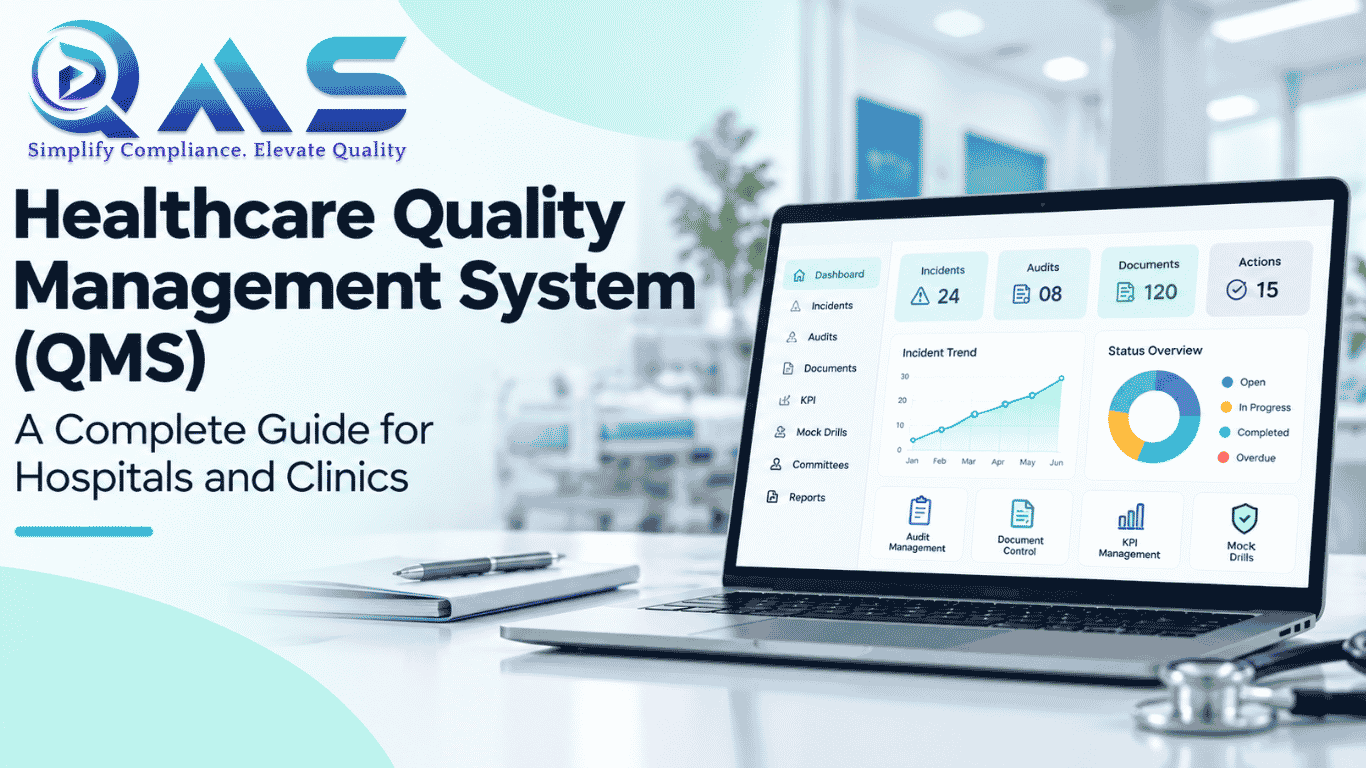
What Is a Healthcare Quality Management System (QMS)?
A Healthcare Quality Management System (QMS) is a structured approach that helps hospitals, clinics, and healthcare organizations manage, measure, and continuously improve the quality and safety of healthcare services. Instead of managing quality activities through disconnected spreadsheets, paperwork, emails, and manual follow-ups, a modern QMS brings important quality processes together in one centralized system.
A healthcare QMS helps organizations establish consistent processes for patient safety, incident management, audits, risk management, corrective and preventive actions (CAPA), document control, quality indicators, compliance, and continuous improvement.
For hospitals and clinics, quality management is not limited to preparing for an accreditation audit. It is an ongoing process of identifying risks, learning from incidents, monitoring performance, improving workflows, and making sure that quality standards are followed across departments.
What Does a Healthcare QMS Manage?
Depending on the organization and its requirements, a modern healthcare QMS can help manage:
- Incident and adverse event reporting
- Corrective and Preventive Actions (CAPA)
- Internal and external audits
- Risk identification and management
- Quality indicators and KPI tracking
- Document and policy control
- Observations and non-conformities
- Compliance and accreditation activities
- Training and competency records
- Mock drills and emergency preparedness
- Quality reports and management dashboards
The goal is simple: give healthcare teams better visibility, stronger accountability, and a transparent way to continuously improve quality and patient safety.
With a digital healthcare QMS, authorized teams can access the information they need from a centralized platform, helping hospitals move from reactive quality management toward a more proactive, data-driven, and continuous quality improvement approach.
Why Healthcare QMS Matters for Hospitals & Clinics
Healthcare quality is not something a hospital can manage once a year during an accreditation audit. It is a continuous responsibility that involves every department, every process, and every level of the organization.
Hospitals and clinics deal with complex workflows every day. From patient care and medication management to infection prevention, documentation, staff training, audits, and incident reporting, even a small gap in a process can affect patient safety, operational efficiency, compliance, and the overall quality of care.
A modern Healthcare Quality Management System gives organizations a structured way to identify these gaps, assign responsibility, track corrective actions, and measure whether improvements are actually working.
Moving From Manual Quality Management to Digital QMS
Traditional quality management often depends on spreadsheets, paper forms, emails, shared folders, and manual follow-ups. As a healthcare organization grows, this can make it difficult to know:
- Which incidents are still pending?
- Who is responsible for a corrective action?
- Which policies need review or approval?
- When was the last audit completed?
- Are recurring issues being identified?
- Are quality indicators improving?
- Can management access accurate information when it is needed?
A digital QMS for hospitals brings these activities into a centralized platform. Authorized users can access relevant quality information from anywhere, while organizations can maintain better visibility, accountability, traceability, and control over their quality processes.
The Role of QMS in Continuous Quality Improvement
A strong QMS is not simply a collection of forms and reports. It creates a continuous improvement cycle:
Identify → Analyze → Act → Monitor → Improve
When this cycle becomes part of everyday hospital operations, quality teams can move beyond simply documenting problems and start using data and insights to prevent recurring issues and improve healthcare processes.
For hospitals and clinics working toward NABH, JCI, or other quality and accreditation requirements, a structured digital quality management approach can also make it easier to organize evidence, monitor compliance activities, and maintain consistent processes across departments.
Core Components of a Modern Healthcare QMS
A modern Healthcare Quality Management System (QMS) should do more than store quality records. It should connect the different activities involved in maintaining and improving healthcare quality, giving teams a clear view of what is happening, what needs attention, and what actions have been completed.
While the exact requirements vary between hospitals, clinics, and healthcare organizations, a comprehensive digital QMS can bring departments, responsibilities, incidents, observations, audits, documents, KPIs, mock drills, committees, reports, and audit logs into one connected platform.
Departments
Healthcare organizations often have multiple departments, locations, specialties, and operational units. A centralized Departments module helps organizations structure their quality processes around the way their organization actually operates.
This makes it easier to assign responsibilities, track activities, and maintain visibility across different areas of a hospital or clinic.
Roles & Permissions
Quality information can be sensitive and should not be accessible to everyone in the same way. Roles & Permissions allow organizations to control what different users can view, create, modify, approve, or manage.
Fine-grained access control helps support secure and accountable quality management across the organization.
Incident Management
A modern QMS should provide a structured way to report and manage incidents and adverse events.
With Incident Management, teams can log an event, triage it, investigate what happened, identify the root cause, initiate CAPA where required, and track the issue through closure.
This creates a transparent record of the complete incident lifecycle instead of relying on disconnected forms or spreadsheets.
Observation Management
Not every quality concern becomes a major incident. Observations allow healthcare teams to capture hazards, near-misses, process gaps, and other concerns early.
Identifying these issues at an early stage can help organizations take preventive action before they develop into more serious quality or patient-safety problems.
Audit Management
Audits are an essential part of healthcare quality management and compliance.
A digital Audit Management module can help teams plan audits, execute them systematically, record findings, assign follow-up actions, and close the audit with a complete history of activities and evidence.
Document Control
Hospitals and clinics manage a large number of SOPs, policies, guidelines, forms, and other controlled documents.
Document Control helps organizations maintain versioned documents with appropriate approvals, review cycles, access control, and traceability, reducing the risk of teams relying on outdated information.
KPI & Quality Indicator Management
Quality improvement needs measurable outcomes.
A KPI Management module allows healthcare organizations to define, collect, monitor, and visualize important quality indicators. Management teams can use this information to identify trends, monitor performance, and understand where improvement efforts are required.
Mock Drills
Preparedness is an important part of healthcare quality and patient safety.
A Mock Drill module can help organizations plan and record drills, evaluate performance, identify gaps, and track improvement actions. This creates a structured way to turn emergency preparedness exercises into measurable improvement opportunities.
Committee Management
Healthcare quality often involves multiple committees and stakeholders.
Committee Management helps structure governance activities, track follow-ups, and maintain accountability for decisions and actions taken by quality and safety committees.
Safety & Statutory Review Committee (SRC)
A dedicated SRC Management workflow can help organizations structure safety and statutory review activities, maintain follow-ups, and keep important governance processes traceable.
Reports & Audit Logs
Quality management becomes significantly more useful when organizations can see what is happening across the system.
Reports provide management visibility into quality activities and performance, while Audit Logs help maintain a transparent record of important system activities and changes.
Together, these capabilities help create a more connected approach to healthcare quality management.
The real value of a modern QMS is not simply having individual modules. It is the ability to connect them into a continuous quality cycle:
Identify → Investigate → Improve → Monitor → Measure → Repeat
For hospitals and clinics, this creates a more transparent, structured, and data-driven approach to quality management, compliance, patient safety, and continuous improvement.
How Healthcare QMS Improves Patient Safety
Patient safety is one of the most important reasons for implementing a Healthcare Quality Management System. In a hospital or clinic, quality problems can originate from many different areas, including communication gaps, process deviations, documentation errors, delayed follow-ups, or unidentified risks.
A digital QMS helps healthcare organizations create a structured system for identifying these issues, investigating them, taking corrective action, and monitoring whether the improvement is effective.
Identify Incidents and Near-Misses Early
A strong patient-safety program should capture more than serious adverse events. Incidents, near-misses, hazards, and observations can provide valuable information about weaknesses in existing processes.
With Incident Management and Observations, healthcare teams can create a structured record of quality and safety concerns and ensure that they are not lost in paperwork or informal communication.
Investigate the Root Cause
Recording an incident is only the first step. Healthcare organizations need to understand why the problem happened and whether similar situations could occur again.
A structured investigation process helps teams move beyond treating individual events and focus on the underlying process or system issues that contributed to them.
Take Corrective and Preventive Action
Once a root cause or quality gap has been identified, appropriate corrective and preventive actions need to be assigned and followed through.
A connected QMS can help teams define actions, assign responsibility, establish deadlines, document evidence, and monitor completion. This creates greater accountability and helps prevent issues from simply being marked as resolved without meaningful follow-up.
Monitor Quality Performance
Patient safety also depends on continuously monitoring whether processes are actually improving.
With KPI Management, hospitals can define and track relevant quality indicators, identify trends, and use measurable information to understand where additional improvement may be required.
Strengthen Audit and Compliance Processes
Regular audits can reveal gaps before they become larger quality or patient-safety concerns. Audit Management provides a structured approach to planning audits, recording findings, tracking actions, and maintaining audit history.
This helps quality teams create a continuous feedback loop between auditing, corrective action, measurement, and improvement.
Give Teams Access to Controlled Information
Patient safety also depends on healthcare professionals having access to the right policies, procedures, and guidelines.
Document Control helps organizations manage controlled documents, maintain versions, track approvals, and ensure that teams work with properly managed information.
Build a Culture of Continuous Improvement
The ultimate goal of a healthcare QMS is not simply to reduce the number of reported problems. It is to create an environment where healthcare teams can identify risks, report concerns, learn from incidents, take action, measure outcomes, and continuously improve.
When these activities are connected through a digital platform, hospitals and clinics can develop a more transparent and proactive approach to patient safety and healthcare quality.
QMS for NABH, JCI & Healthcare Compliance
For hospitals and clinics, quality management is closely connected with compliance, accreditation, patient safety, and consistent healthcare processes. A modern Healthcare Quality Management System can help organizations organize the activities, evidence, responsibilities, and follow-ups required to maintain quality standards.
Supporting NABH and Accreditation Readiness
For organizations preparing for NABH accreditation or reassessment, maintaining organized quality records and evidence is an important part of the overall quality process.
A digital QMS can help teams manage activities such as audits, incidents, observations, corrective actions, policies, quality indicators, committees, and reports from a centralized platform.
Instead of searching through multiple spreadsheets, folders, emails, and paper records, quality teams can maintain a structured digital trail of their activities.
Supporting JCI and International Quality Practices
Healthcare organizations operating with international quality frameworks also need consistent processes, clear accountability, reliable documentation, and continuous monitoring.
A modern QMS can provide a centralized environment for managing quality activities across departments while giving authorized users secure access to relevant information.
This approach can be particularly useful for healthcare organizations that want their quality management processes to support both local accreditation requirements and internationally oriented quality practices.
Centralized Compliance Evidence
Compliance activities generate a significant amount of information. Audits, observations, incidents, corrective actions, policies, committee activities, and quality indicators can all contribute to an organization's quality record.
With Reports, organizations can bring quality information together for management review and ongoing monitoring.
Audit Management can also help teams maintain structured audit records, findings, and follow-up activities.
Controlled Policies and Procedures
Compliance is not only about maintaining evidence. Healthcare teams also need access to current and approved policies and procedures.
With Document Control, organizations can manage document versions, approvals, review cycles, and traceability in a more structured way.
Making Compliance a Continuous Process
A healthcare QMS should not be treated as a system that is used only when an accreditation assessment is approaching.
The stronger approach is to make quality and compliance part of everyday operations:
Plan → Implement → Monitor → Audit → Correct → Measure → Improve
When quality activities are continuously recorded and monitored, hospitals and clinics can build a more organized, transparent, and sustainable approach to healthcare compliance and continuous quality improvement.
Incident Management, CAPA & Risk Management
Quality improvement becomes meaningful when healthcare organizations can move from identifying a problem to understanding its cause, taking action, and verifying that the problem has been addressed.
A modern Healthcare QMS connects these activities into a structured workflow so that incidents, observations, corrective actions, and risks can be managed consistently across departments.
From Incident Reporting to Root Cause Analysis
An incident should not simply be recorded and forgotten. Healthcare teams need to understand what happened, why it happened, and whether the same issue could occur again.
With Incident Management, organizations can follow a structured workflow from logging and triage through investigation, root cause analysis, CAPA, and closure.
This creates a traceable history of the issue and the actions taken to address it.
Corrective and Preventive Action (CAPA)
CAPA is an important part of an effective quality management process.
Corrective action focuses on addressing an existing problem, while preventive action focuses on reducing the possibility of similar problems occurring in the future.
An effective CAPA process should make it possible to:
- Identify the quality problem
- Investigate the root cause
- Define corrective and preventive actions
- Assign responsibility
- Set target dates
- Track progress
- Maintain supporting evidence
- Verify effectiveness
- Close the action with proper accountability
When CAPA is connected to incident and observation workflows, quality teams can maintain a clearer relationship between the problem, root cause, action, and outcome.
Managing Observations and Near-Misses
Some of the most valuable quality information can come from issues that did not result in harm.
Observation Management allows teams to capture hazards, near-misses, and process gaps early. These observations can help organizations identify weaknesses before they develop into more serious incidents.
Identifying and Managing Risks
Risk management allows healthcare organizations to take a proactive approach rather than waiting for an incident to occur.
Teams can identify potential risks, assess their significance, determine appropriate mitigation measures, assign responsibility, and monitor the status of those actions.
The objective is not simply to maintain a risk register. It is to make risk information part of everyday quality decision-making.
Closing the Quality Improvement Loop
The strongest approach connects incidents, observations, root cause analysis, CAPA, audits, and performance measurement.
For example:
Incident → Investigation → Root Cause → CAPA → Verification → KPI Monitoring → Continuous Improvement
This connected approach helps hospitals and clinics move from simply documenting problems to learning from them and systematically improving the quality and safety of healthcare services.
Audit, Document & Policy Management
Effective healthcare quality management depends on more than identifying problems. Hospitals and clinics also need a reliable way to audit processes, manage controlled documents, track findings, and ensure that quality activities remain visible and accountable.
A digital QMS brings these activities into a structured environment, helping quality teams reduce manual work and maintain a clear history of quality-related activities.
Streamlined Audit Management
Audits help organizations evaluate whether established processes are being followed and where improvements may be required.
With Audit Management, teams can organize audits, record findings, assign responsibilities, track follow-up actions, and maintain an accessible history of completed audits.
This makes it easier to move from an audit finding to a documented improvement action.
Managing Quality Documents and Policies
Hospitals manage hundreds of documents, including policies, SOPs, procedures, guidelines, forms, and other controlled information.
With Document Control, organizations can centralize important quality documents and manage their lifecycle more systematically.
A structured document management process can help teams maintain:
- Document versions
- Review and approval workflows
- Document ownership
- Review dates
- Controlled access
- Document history and traceability
This reduces the risk of teams using outdated or unauthorized versions of important policies and procedures.
Connecting Audits With Improvement
An audit becomes more valuable when its findings lead to measurable action.
For example, an audit may identify a process gap. The organization can document the finding, assign responsibility, establish a corrective action, monitor completion, and later review whether the change actually improved the process.
This creates a continuous connection between audit findings, corrective action, monitoring, and quality improvement.
Maintaining Transparency and Traceability
Quality teams and management often need to understand not only what changed, but also when an important activity occurred and who performed it.
Audit Logs can provide an additional layer of traceability by maintaining a record of relevant system activities.
Together, audit management, document control, and audit logs help create a more organized and transparent quality environment for modern hospitals and clinics.
Quality Indicators, KPIs & Continuous Improvement
Healthcare quality should be measurable. Hospitals and clinics need more than individual incident reports or audit findings to understand whether their quality initiatives are actually producing better outcomes.
A modern Healthcare Quality Management System helps organizations turn quality data into meaningful information that can support better decisions and continuous improvement.
Tracking Quality Indicators
Quality indicators help organizations measure important aspects of healthcare performance and identify changes over time.
With KPI Management, healthcare teams can define relevant indicators, record performance data, monitor trends, and identify areas that require attention.
Depending on the organization, these indicators may cover areas related to patient safety, clinical quality, operational performance, compliance, incidents, audits, and other quality objectives.
Turning Data Into Action
Collecting data alone does not improve quality. The real value comes from understanding what the data is showing and deciding what action should follow.
For example, if a quality indicator consistently moves outside its expected range, the quality team can investigate the underlying process, review related incidents or observations, and determine whether corrective action is required.
This creates a practical connection between:
Data → Analysis → Action → Measurement → Improvement
Real-Time Visibility for Management
Quality managers and hospital leadership need a clear view of current performance rather than waiting for manually prepared reports.
A centralized QMS can make important quality information easier to access and review, helping decision-makers understand what is improving, what is declining, which actions are pending, and where attention is required.
Supporting Continuous Quality Improvement
Continuous quality improvement means treating quality as an ongoing process rather than a one-time project.
Hospitals can use KPI trends, audit findings, incident information, observations, and corrective actions together to identify opportunities for improvement.
Over time, this creates a quality culture where teams can:
- Measure current performance
- Identify gaps
- Understand underlying causes
- Implement improvements
- Monitor results
- Adjust processes when necessary
- Measure performance again
A modern QMS therefore becomes more than a compliance tool. It becomes a data-driven quality improvement platform that helps hospitals and clinics make informed decisions and continuously strengthen the quality and safety of healthcare services.
Mock Drills, Preparedness & Quality Governance
Healthcare quality also depends on how well an organization prepares for emergencies, reviews its readiness, and ensures that important quality decisions have clear ownership.
A modern Healthcare Quality Management System can help hospitals and clinics bring preparedness activities and quality governance into a structured digital workflow.
Planning and Managing Mock Drills
Mock drills help healthcare organizations evaluate how teams respond to emergency and safety situations.
With Mock Drills, organizations can plan drills, record participation and observations, document gaps, and track improvement actions.
The purpose is not simply to complete a drill. It is to identify weaknesses, learn from the exercise, and improve preparedness before a real emergency occurs.
Structured Quality Committee Management
Healthcare quality involves multiple stakeholders, departments, and committees. Important decisions and follow-up actions need to remain organized and accountable.
Committee Management can help organizations structure committee activities, maintain follow-ups, and keep important quality governance information organized.
Safety & Statutory Reviews
Safety and statutory review activities can involve multiple actions, observations, decisions, and follow-ups.
With SRC Management, organizations can maintain a structured approach to safety and statutory review activities while keeping important follow-up information accessible.
Connecting Preparedness With Continuous Improvement
Mock drills and committee reviews become more valuable when their findings lead to measurable improvement.
A gap identified during a drill can become an observation, lead to a corrective action, and later be reviewed to determine whether the improvement was effective.
This creates another important quality cycle:
Prepare → Test → Identify Gaps → Improve → Review → Strengthen Readiness
By connecting preparedness, governance, and quality improvement, hospitals and clinics can build a more organized, accountable, and proactive approach to patient safety and operational readiness.
Benefits of a Digital Healthcare QMS for Hospitals & Clinics
Moving from manual quality management to a digital Healthcare Quality Management System can change how hospitals and clinics manage quality, compliance, patient safety, and continuous improvement.
Instead of relying on disconnected spreadsheets, paper records, emails, and manual follow-ups, teams can work through a centralized system with controlled access and better visibility.
Centralized Quality Management
A digital QMS brings important quality activities together in one platform, including incidents, observations, audits, documents, KPIs, mock drills, committees, reports, and other quality processes.
This gives quality teams a more consistent way to manage activities across departments.
Access Quality Information From Anywhere
Modern healthcare organizations may have multiple departments, locations, and teams. A centralized digital platform allows authorized users to access relevant quality information when and where they need it.
This can support faster communication, better collaboration, and more informed decision-making without depending entirely on physical records or a particular workstation.
Better Transparency and Accountability
Every quality action should have clear ownership.
With structured workflows and Roles & Permissions, organizations can control access based on responsibilities while maintaining clearer accountability for quality activities.
Audit Logs can also provide traceability of relevant system activities.
Improved Data Security and Controlled Access
Healthcare quality information can contain sensitive organizational and operational data. A modern QMS should therefore provide appropriate access controls and structured permissions.
Instead of giving every user unrestricted access, organizations can determine which information and functions are available to different roles.
Faster Reporting and Decision-Making
Manually preparing quality reports can consume significant time.
With centralized Reports, quality teams and management can access organized quality information more efficiently and use it to identify trends, pending actions, and areas requiring attention.
Reduced Manual Work
Digital workflows can reduce repetitive administrative work associated with maintaining spreadsheets, manually following up on actions, searching through documents, and compiling information for reviews.
This allows quality professionals to spend more time analyzing problems and improving processes rather than simply managing paperwork.
Scalable Quality Management
As a hospital or healthcare organization grows, its quality processes also become more complex.
A digital QMS provides a structured foundation that can support additional departments, users, quality activities, and reporting requirements as the organization evolves.
Ultimately, the value of digital QMS software is not simply that it replaces paper. It helps create a more connected, transparent, accessible, secure, and measurable approach to healthcare quality management.
How to Choose the Right Healthcare QMS Software
Choosing a Healthcare Quality Management System is an important decision for hospitals and clinics because the software needs to support everyday quality operations, not just accreditation activities.
Before selecting a QMS, organizations should evaluate how well the platform fits their existing workflows, quality objectives, security requirements, and future growth.
Look for Comprehensive QMS Capabilities
A healthcare QMS should cover the quality processes your organization actually needs, including incident management, observations, audits, document control, KPIs, mock drills, committees, reporting, and audit trails.
A platform with connected modules can reduce the need to manage quality activities across multiple disconnected tools.
Evaluate Security and Access Control
Healthcare organizations handle sensitive information, so security should be considered from the beginning.
Look for features such as role-based access, permissions, controlled data access, secure authentication, and activity traceability.
The right system should allow organizations to give users access to the information and functionality required for their responsibilities without unnecessarily exposing other data.
Check Accessibility and Availability
Quality teams and management may need access to information from different departments, locations, or devices.
A modern QMS should provide convenient access to authorized users while maintaining appropriate security controls. This is particularly useful for organizations operating across multiple locations or with distributed quality teams.
Consider Reporting and Analytics
A QMS should make quality information easier to understand, not simply store it.
Evaluate whether the platform provides useful reports, dashboards, KPI tracking, trends, and quality insights that can support management reviews and continuous improvement.
Evaluate Ease of Use
Even a feature-rich QMS will not deliver its full value if healthcare teams find it difficult to use.
The interface should be intuitive enough for quality managers, department heads, administrators, and other authorized users to understand their workflows without unnecessary complexity.
Check Scalability
Your QMS should be able to grow with your organization.
Consider whether it can support additional departments, users, locations, quality processes, reporting requirements, and future operational needs without requiring a complete change of system.
Review Auditability and Traceability
Quality management requires accountability.
Features such as audit logs, activity history, document versions, approvals, and action tracking can help organizations maintain a clear record of important quality activities.
Think Beyond Accreditation
NABH or JCI readiness may be an important requirement, but a QMS should provide value throughout the year.
The strongest approach is to select software that helps your organization continuously manage quality, patient safety, compliance, risk, performance, and improvement, rather than using it only when an accreditation assessment is approaching.
Ultimately, the right healthcare QMS should make quality management simpler, more transparent, more measurable, and easier to manage at scale.
DvertoQMS: A Modern Healthcare Quality Management System
Healthcare quality management is becoming increasingly digital. Hospitals and clinics need more than disconnected spreadsheets, paperwork, and manual follow-ups to manage quality, compliance, patient safety, and continuous improvement.
DvertoQMS is a modern Healthcare Quality Management System designed to bring these quality activities together in one centralized platform.
From incident reporting and observations to audits, document control, KPIs, mock drills, committees, reports, and audit logs, DvertoQMS provides healthcare organizations with a structured digital environment for managing quality across their organization.
One Platform for Complete Quality Management
DvertoQMS brings essential quality workflows together so teams can manage them from a single platform.
Organizations can manage:
- Departments
- Roles & Permissions
- Incident Management
- Observation Management
- Audit Management
- Document Control
- KPI Management
- Mock Drills
- Committee Management
- SRC Management
- Reports
- Audit Logs
This connected approach helps organizations move away from fragmented quality processes and create a more structured quality management environment.
Designed for Hospitals, Clinics & Healthcare Organizations
DvertoQMS can support different types and sizes of healthcare organizations, from hospitals and clinics to larger healthcare groups with multiple departments and locations.
The platform is designed to help quality teams, department heads, administrators, and management work from a common quality management environment while maintaining appropriate access controls.
Secure and Transparent Access
Quality information needs to be accessible to the right people while remaining protected through appropriate permissions.
DvertoQMS supports role-based access and controlled permissions, helping organizations determine what different users can access and manage.
With centralized information and activity traceability, quality teams can maintain better visibility into their processes and responsibilities.
Quality Management From Anywhere
Modern healthcare teams cannot always depend on being in one location to access quality information.
DvertoQMS enables authorized users to work with their quality processes through a centralized digital platform, helping teams access relevant information and manage activities more efficiently across locations.
Built for Continuous Quality Improvement
DvertoQMS is not designed only for accreditation preparation.
It helps organizations create a continuous cycle of:
Identify → Investigate → Improve → Monitor → Measure
By connecting incidents, observations, audits, documents, KPIs, reports, and governance activities, organizations can develop a more proactive and data-driven approach to healthcare quality.
A Modern Approach to Healthcare Quality
For hospitals and clinics looking to move from manual quality management toward a modern, centralized, transparent, and technology-driven QMS, DvertoQMS provides a foundation for managing quality and continuous improvement in one place.
Explore DvertoQMS:
Visit DvertoQMS to learn more about the platform and its healthcare quality management capabilities.
Related Blogs
More in Healthcare
Clinic Management Software for Better Patient Experience
clinic management software patient experience in clinics, clinic management software India...
How Digital Tools Can Reduce Administrative Work for Indian Clinics
digital tools for clinics patient experience in clinics, clinic management software India,...
Hospital Management Software Cost in India 2026: Complete Pricing Guide
How much does hospital management software cost in India? Explore pricing models, features...
10 Signs Your Hospital Needs a Hospital Information System (HIS)
Is your hospital still relying on paper records or disconnected systems? Discover the top ...

Why Every Hospital Needs a Hospital Management System in 2026 ?
A Hospital Information System (HIS) helps hospitals connect clinical, administrative, and ...